Skin Boosters vs Polynucleotides
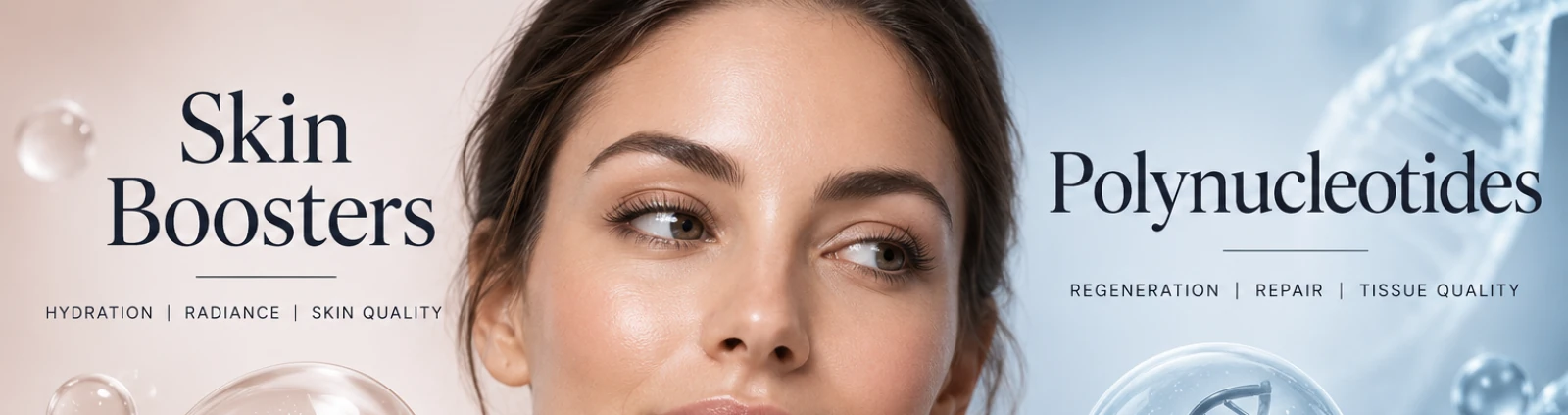
Skin boosters and polynucleotides have become two of the most talked-about treatments for improving skin quality. Both can be used as part of a wider skin rejuvenation plan, both are delivered through injectable treatment protocols, and both are often discussed alongside treatments such as dermal fillers.
However, they are not the same thing.
Traditional hyaluronic acid skin boosters primarily focus on improving hydration and overall skin quality, while polynucleotides are increasingly used where the treatment objective is centred on skin regeneration, tissue quality and progressive dermal improvement.
There is also an important complication. The categories increasingly overlap. Some modern injectable products combine hyaluronic acid (HA) and polynucleotides (PN) within the same formulation, meaning practitioners need to look beyond the words “skin booster” on the packaging and understand exactly what a product contains.
In this article, we look at the difference between skin boosters and polynucleotides, how each works, where PN and PDRN fit into the picture, and what practitioners should consider when selecting products for their patients.
What Is a Skin Booster?
A skin booster is an injectable treatment designed primarily to improve the quality of the skin rather than create the structural volume or contouring normally associated with a dermal filler.
Many traditional skin boosters use hyaluronic acid as their main active ingredient. HA is naturally present within the body and has a strong capacity to bind water, which is one reason it is so widely used within aesthetic medicine.
When appropriately selected and administered, HA skin boosters can be used to target concerns such as:
- dehydrated or dull-looking skin;
- loss of elasticity;
- fine lines;
- rough or uneven skin texture;
- reduced radiance;
- early signs of skin ageing.
A systematic review of injectable HA treatments found promising evidence for improvements in areas including hydration, firmness, texture, radiance and elasticity, although the formulations and treatment protocols used across studies varied.
Practitioners looking at this category can explore the Aesthetics Wise skin booster range, which includes a variety of formulations designed for different treatment objectives and anatomical areas.
Are Skin Boosters the Same as Dermal Fillers?
No. Although both may contain hyaluronic acid, the intended treatment objective can be very different.
Traditional dermal fillers are commonly selected to provide structural support, replace or enhance volume, alter contour or address particular anatomical features. A skin booster is generally selected to improve skin quality rather than facial shape or projection.
This distinction is important when consulting with patients.
A patient saying that they want their skin to look “fresher” does not automatically need dermal filler. Likewise, a patient seeking meaningful structural correction is unlikely to achieve that objective simply through a conventional non-volumising skin booster.
The product should follow the treatment objective, not the other way around. Start with the patient’s anatomy, skin quality, concerns and expectations before deciding which injectable category is appropriate.
What Are Polynucleotides?
Polynucleotides, usually shortened to PN, are DNA-derived biopolymers that have become increasingly prominent within regenerative aesthetics.
Aesthetic PN products are commonly produced from highly purified fish-derived DNA. Depending on the specific formulation, they are used with the objective of supporting the biological environment of the skin and encouraging processes associated with tissue repair and dermal remodelling.
Published research into polynucleotides has reported potential improvements in areas such as:
- skin texture;
- elasticity;
- fine lines and wrinkles;
- hydration;
- overall skin quality;
- tissue regeneration and repair.
However, practitioners should be careful not to overstate the evidence. Polynucleotides are a rapidly developing area of aesthetic medicine and, while the available research is promising, reviews continue to highlight differences between products, protocols and study methodologies. Larger and better standardised clinical trials are still needed.
This is particularly important when discussing expected outcomes with patients. Terms such as “regenerative” should not be interpreted as meaning that a treatment can completely reverse skin ageing or repair every type of tissue damage.
What Is the Difference Between PN and PDRN?
You will frequently see the terms PN and PDRN used when researching polynucleotide products. They are closely related, but technically they are not identical.
PN refers broadly to polynucleotides, while PDRN stands for polydeoxyribonucleotide. Scientific literature describes differences in molecular size and biological behaviour between the two.
PN generally consists of longer DNA polymer fragments and is associated with extracellular matrix and tissue remodelling. PDRN typically consists of shorter DNA-derived fragments, with research investigating mechanisms including adenosine A2A receptor activity and nucleotide salvage pathways.
In the aesthetics market, however, PN and PDRN terminology is sometimes used inconsistently or interchangeably. This has been specifically highlighted within scientific reviews.
For practitioners, the practical lesson is simple: do not select a product based purely on whether the marketing material says PN or PDRN. Check the manufacturer’s documentation, composition, concentration, intended use and recommended treatment protocol for the individual product.
Skin Boosters vs Polynucleotides: The Key Differences
| Consideration | HA Skin Boosters | Polynucleotides |
|---|---|---|
| Primary focus | Hydration and improvement in skin quality | Skin quality, tissue support and regenerative processes |
| Main ingredient | Usually hyaluronic acid | PN or PDRN DNA-derived polymers |
| Typical objective | Hydration, radiance, texture and elasticity | Progressive improvement in texture, elasticity and tissue quality |
| Volume | Usually minimal compared with conventional dermal filler, although this depends on formulation | Generally selected for skin quality rather than structural volumisation |
| Treatment areas | Commonly face, neck, décolletage and hands depending on product | Commonly face, neck, décolletage and targeted periorbital areas depending on product |
| Evidence base | HA has a substantial established evidence base within aesthetic medicine | Promising and expanding evidence, although further high-quality comparative research is needed |
These are general distinctions rather than universal rules. Individual products can behave differently depending on their formulation, molecular characteristics, concentration and additional ingredients.
Hydration vs Regeneration: Is It Really That Simple?
You will often see the comparison reduced to:
Skin boosters = hydration
Polynucleotides = regeneration
That is useful as a starting point, but it is an oversimplification.
HA skin boosters are not necessarily limited to temporary surface hydration. Research into injectable HA has identified improvements in several skin-quality parameters, and certain formulations may influence biological processes within the dermis.
Similarly, polynucleotides are not completely separate from hydration. Improvements in hydration have also been reported following PN treatments.
The better way to compare them is by looking at the primary treatment objective and the characteristics of the individual formulation.
Can a Product Contain Both HA and Polynucleotides?
Yes, and this is where the traditional distinction between the two categories becomes increasingly blurred.
Some newer formulations combine polynucleotides with hyaluronic acid and, in some cases, peptides or other ingredients. These products are designed to address more than one aspect of skin quality within a single treatment strategy.
For example, iLLUMA PN Booster combines polynucleotides with hyaluronic acid and peptides, while products such as Lumi Naju combine PDRN, HA and additional ingredients.
This illustrates why “skin booster vs polynucleotide” is no longer always a straightforward either/or decision.
When Might an HA Skin Booster Be Considered?
An HA-based skin booster may be considered where the consultation identifies concerns predominantly associated with hydration and general skin quality.
For example, a patient may have relatively healthy skin structure but complain that their complexion looks dry, tired or dull. They may be more interested in improved hydration and radiance than structural facial changes.
Depending on the patient’s suitability and the specific product, an HA skin booster may therefore form part of the treatment plan.
The important point is that “skin booster” describes a broad treatment category. Practitioners should assess the individual product rather than assuming every HA skin booster has the same characteristics.
When Might Polynucleotides Be Considered?
Polynucleotides may be considered where the treatment objective is more strongly focused on progressive improvement in skin quality and tissue condition.
This could include patients concerned about:
- fine lines and early signs of ageing;
- reduced elasticity;
- thin or crepey-looking skin;
- poor overall skin quality;
- the appearance of the periorbital area;
- progressive rather than volumising rejuvenation.
Different PN formulations are intended for different areas and treatment objectives, so product selection remains important.
For example, Aesthetics Wise stocks specialist ranges including Plinest polynucleotides, Vitaran skin boosters and Nucleofill polynucleotides, with different formulations available for general skin rejuvenation and more targeted areas.
What About the Under-Eye Area?
The periorbital area is one of the reasons polynucleotides have attracted so much interest within aesthetic practice.
Patients may present with concerns including fine lines, crepey skin, loss of elasticity or changes in overall skin quality around the eyes. These concerns are not necessarily caused by a simple lack of volume.
That distinction matters.
Adding volume is not automatically the correct approach to every under-eye concern. Careful assessment is required to determine whether the patient’s concern relates to volume loss, pigmentation, skin quality, vascular visibility, fluid retention or a combination of factors.
Specific PN formulations have been developed for this delicate anatomical area, including products such as iLLUMA Luna and Plinest Eye.
Practitioners should only use products according to their intended use, manufacturer instructions, training, competence and appropriate clinical assessment.
Can You Combine Skin Boosters and Polynucleotides?
Potentially, yes. They do not necessarily need to compete for a place within a treatment plan.
A practitioner may determine that different products or treatment modalities address different aspects of a patient’s concerns. However, combining or sequencing treatments should be based on clinical assessment, product instructions, patient history and an appropriate treatment plan rather than simply offering more procedures.
Practitioners also need to consider timing, treatment area, injection technique, contraindications and how the skin is expected to respond between sessions.
More treatment is not automatically better treatment.
How Should Practitioners Choose Between Skin Boosters and Polynucleotides?
Product selection should begin during the consultation rather than at the point of ordering stock.
1. Identify the Primary Treatment Objective
Ask what the patient actually wants to improve.
“I want better skin” could mean dehydration, pigmentation, fine lines, laxity, volume loss, scarring, under-eye concerns or simply a desire for greater radiance.
These are different problems and may require different approaches.
2. Assess the Skin and Anatomy
A treatment should never be selected purely because it is currently popular.
Consider skin quality, thickness, elasticity, hydration, anatomy, previous treatments and any relevant medical factors before recommending an injectable procedure.
3. Look at the Actual Formulation
Do not rely solely on product-category terminology.
Check:
- active ingredients;
- HA concentration where applicable;
- PN or PDRN content;
- additional ingredients;
- intended treatment area;
- manufacturer instructions;
- recommended protocol;
- contraindications;
- storage requirements;
- traceability and product provenance.
4. Consider Patient Expectations
A patient expecting a dramatic change in facial structure may be disappointed by a treatment designed primarily to improve skin quality.
Conversely, someone seeking subtle improvement without obvious volumisation may not want a traditional filler-led approach.
Good consultation and expectation management are therefore just as important as product selection.
5. Consider the Full Treatment Journey
Skin-quality treatments are often delivered as a course rather than as an isolated appointment.
Practitioners should therefore consider the manufacturer’s recommended protocol, potential maintenance requirements, total treatment cost, expected downtime and whether the patient can realistically commit to the complete plan.
What Are the Risks?
Skin boosters and polynucleotides are injectable procedures, so they should never be presented as risk-free simply because the desired outcome is subtle or non-volumising.
Depending on the treatment and technique, potential adverse effects can include:
- pain or tenderness;
- bruising;
- swelling;
- redness;
- temporary papules or visible injection points;
- infection;
- inflammatory reactions;
- allergic or hypersensitivity reactions;
- other injection-related complications.
The precise risk profile depends on the product, treatment area, injection depth and technique, as well as individual patient factors.
Practitioners should understand the anatomy of the treatment area, recognise complications, maintain appropriate infection-control standards and have suitable procedures in place for managing adverse events.
What About Fish Allergies and Polynucleotides?
Many aesthetic PN and PDRN products are derived from purified salmon or trout DNA.
Practitioners should therefore establish the origin and composition of the specific product being used and follow its manufacturer’s contraindications and safety information. Relevant allergies and medical history should form part of a thorough consultation.
Do not assume that the safety information for one polynucleotide product automatically applies to another.
UK Regulation of Skin Boosters and Polynucleotides
The UK regulatory environment surrounding non-surgical aesthetics continues to develop.
In England, the government has committed to introducing greater regulation of non-surgical cosmetic procedures. Previous proposals have included a licensing framework covering practitioners and premises, with injectable hyaluronic acid and biorevitalisation procedures among the treatments considered within the proposed framework.
As of September 2026, practitioners should therefore distinguish between current legal requirements and proposed future licensing requirements. A government consultation or announced policy direction should not be treated as though every proposed requirement is already in force.
Practitioners and clinic owners should monitor current guidance from GOV.UK on the licensing of non-surgical cosmetic procedures and understand the regulatory position applicable to their location, profession, products and treatments.
The Medicines and Healthcare products Regulatory Agency (MHRA) is responsible for regulating medicines and medical devices within the UK. Product status can differ between injectable products, making it important for clinics to understand what they are purchasing and how a manufacturer intends the product to be used.
Alongside legal requirements, good practice should include appropriate training and competence, informed consent, consultation, medical-history screening, treatment documentation, infection control, batch traceability, appropriate insurance and robust complication-management procedures.
Product Traceability Matters
With an expanding market for skin boosters and polynucleotides, sourcing should form part of a clinic’s wider risk-management process.
Practitioners should be able to identify what was administered, where it came from and which batch was used.
Good stock management should include recording relevant information such as:
- product name and manufacturer;
- supplier;
- batch or lot number;
- expiry date;
- storage requirements;
- date administered;
- quantity used;
- treatment area;
- patient treatment record.
This information becomes particularly important if a manufacturer issues a safety notice, a patient develops a delayed reaction or a product needs to be traced after treatment.
Skin Booster or Polynucleotide: Which Is Better?
Neither category is automatically “better”. They are different tools.
If the primary concern is hydration, radiance and general skin quality, an HA-based skin booster may be an appropriate option following assessment.
If the objective is centred more heavily on progressive skin-quality improvement, dermal support and regenerative processes, a polynucleotide formulation may be considered.
For some patients, a combination product containing both HA and PN may fit the treatment objective. For others, neither option may be appropriate.
The decision should always come back to the same question:
What are we actually trying to improve for this patient?
Once that is established, practitioners can compare formulations rather than simply comparing product names or following whichever injectable is receiving the most attention on social media.
Frequently Asked Questions
Are polynucleotides a type of skin booster?
The terminology can overlap. “Skin booster” is commonly used as a broad commercial description for injectable treatments intended to improve skin quality. Some products marketed as skin boosters contain HA, some contain polynucleotides, and others combine the two. It is therefore more useful to look at the formulation than the category name alone.
Are polynucleotides the same as hyaluronic acid?
No. Hyaluronic acid is a glycosaminoglycan naturally found throughout the body and is widely used in aesthetic injectables. Polynucleotides are DNA-derived polymers. They have different molecular structures and mechanisms, although both may be used with the objective of improving skin quality.
Are PN and PDRN the same thing?
They are closely related but not technically identical. Scientific literature identifies differences in their molecular size and biological activity. However, PN and PDRN are sometimes used interchangeably within aesthetic marketing, so practitioners should check the composition of the individual product.
Do polynucleotides add facial volume?
Polynucleotide treatments are generally selected for skin-quality and regenerative objectives rather than the structural volumisation associated with conventional dermal fillers. The behaviour of an individual injectable still depends on its complete formulation, particularly where HA or other ingredients are also present.
Can skin boosters and polynucleotides be used around the eyes?
There are products specifically formulated for periorbital use, including polynucleotide treatments. The eye area requires careful assessment and specialist anatomical knowledge. Practitioners should only use a product in accordance with its intended use, instructions and their own training and competence.
How many treatments are normally required?
There is no single protocol covering every skin booster or polynucleotide product. Courses frequently involve multiple sessions followed by maintenance, but intervals and treatment numbers vary considerably. Always follow the protocol for the individual formulation and adapt treatment planning following appropriate patient assessment.
Are polynucleotides better than dermal fillers?
They serve different purposes. Dermal fillers can be used for structural support, contour and volume, whereas PN treatments are generally focused on skin quality and regenerative objectives. One should not automatically be considered a replacement for the other.
Can HA and polynucleotides be in the same injectable?
Yes. A growing number of products combine HA and PN or PDRN. This is why practitioners should review the complete formulation rather than assuming every product belongs neatly within a single category.
Final Thoughts on Skin Boosters vs Polynucleotides: Choose the Treatment for the Patient
The growing popularity of polynucleotides has given practitioners another option for patients seeking improvements in skin quality without necessarily changing facial structure.
Traditional HA skin boosters remain particularly relevant for hydration, texture, elasticity and radiance, while polynucleotides have created greater interest in regenerative approaches to skin rejuvenation. Increasingly, hybrid formulations are bringing those two approaches together.
The most important distinction is therefore not simply skin booster vs polynucleotide. It is understanding the patient’s concern, identifying the treatment objective and then choosing a formulation with characteristics that genuinely support that objective.
For UK practitioners, that should sit alongside appropriate training, patient assessment, informed consent, product knowledge, traceability and ongoing awareness of the changing regulatory environment.
Explore the complete Aesthetics Wise skin booster range, including HA, PN and PDRN formulations from established aesthetic brands.
Further Reading and Professional Resources
- GOV.UK: Licensing of Non-Surgical Cosmetic Procedures
- Medicines and Healthcare products Regulatory Agency (MHRA)
- PubMed: Systematic Review of Injectable Hyaluronic Acid and Facial Skin Quality
- PubMed: Systematic Review of Polynucleotides in Aesthetic Medicine
- PubMed: Comparison of Polynucleotide and Polydeoxyribonucleotide
Professional note: This article is intended as general information for aesthetics professionals and does not replace manufacturer instructions, appropriate clinical training, professional guidance or individual patient assessment.